Tag Archives: medieval art

Staying in

The other day a few women I was talking to agreed among themselves how happy they would be to just stay in, cozy in their own homes, instead of being obliged to go out to various other places so frequently.

And I thought there’s something to agree with in that, as I too really enjoy staying home, where everything is just as I prefer it, comfortable, cozy, and quiet.

So I thought to find a picture of someone snug in their bed in order to illustrate the idea, which led to a rather surprising discover: in searching medieval art, most depictions of people in bed are rather drama-filled. Besides the expected depictions of adultery, there are many other interesting categories of illustration:

One of the most beautiful is of poor Tobit getting a blinding eye-full of bird poo, which leads to all sorts of interesting adventures (See the Book of Tobit in the Bible for the full story). This one is worth a close look. Such beautiful detail, from the fabrics to the mechanics of the cooking setup, and, well, to the providential bird.

Being killed in bed is not uncommon, as many images depict. Or, as in the following, being awakened to receive the news that other people have been killed:

Of course there is being dead in bed, with scenes of mourners, angels or devils gathered around you. This one is especially spectacular, as it is the death of the Virgin Mary, with all of Heaven gathered around her to carry her up (by tradition she rose bodily into Heaven, rather than just in spirit).

/

If one isn’t dead yet, one might be sick, and pictures of people being attended to while sick are common. Here’s King Louis IX being healed by a piece of the True Cross:

Of course, childbirth is often centered around a bed in art from this period, and in many cases the pictures include adjacent scenes of midwives washing the child, servants bringing food to the tired mother, and family members peeking in from nearby. This is the birth of John the Baptist, in a beautifully detailed architectural setting:
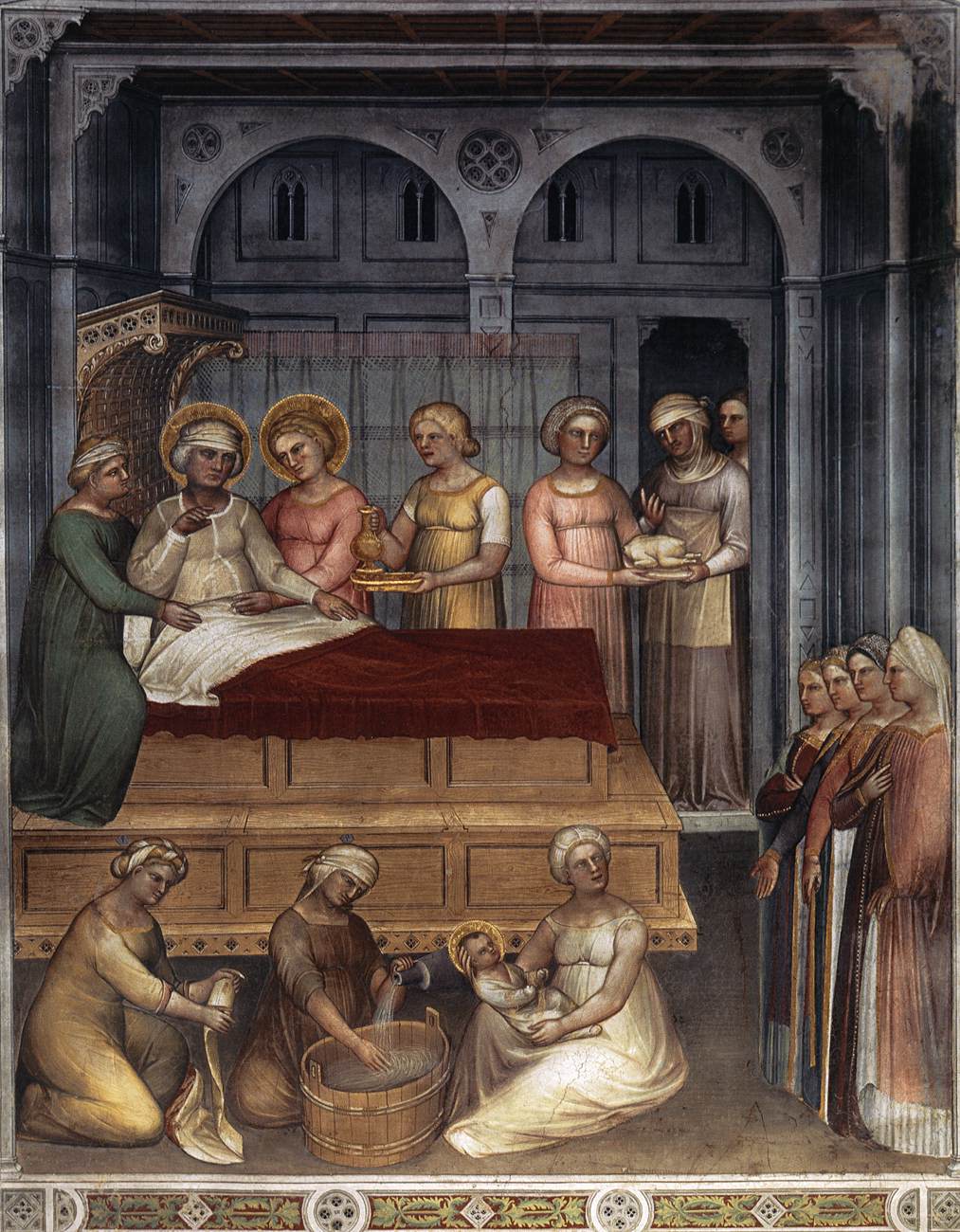
And finally, there is socializing in bed, or at least near the bed. It’s not uncommon for scenes of (usually royal) meetings being held with the bed centrally featured in the scene, even if it is neatly made and not being used. Here are a couple examples:

First, a Bavarian queen receiving a gift:

And here, a French king receiving visitors:

Weather

“…we are filled with wonderment at the changes we see in the seasons and the weather…” St. Montfort, quoted in my previous post

I’m not sure wonderment is quite what we are filled with most of the time. Complaint might be a better description. Is there any weather condition that doesn’t inspire complaint? If I don’t complain about today’s weather someone else will do it for me.

Master of the Geneva Boccaccio, Public domain, via Wikimedia Commons

Medieval trees

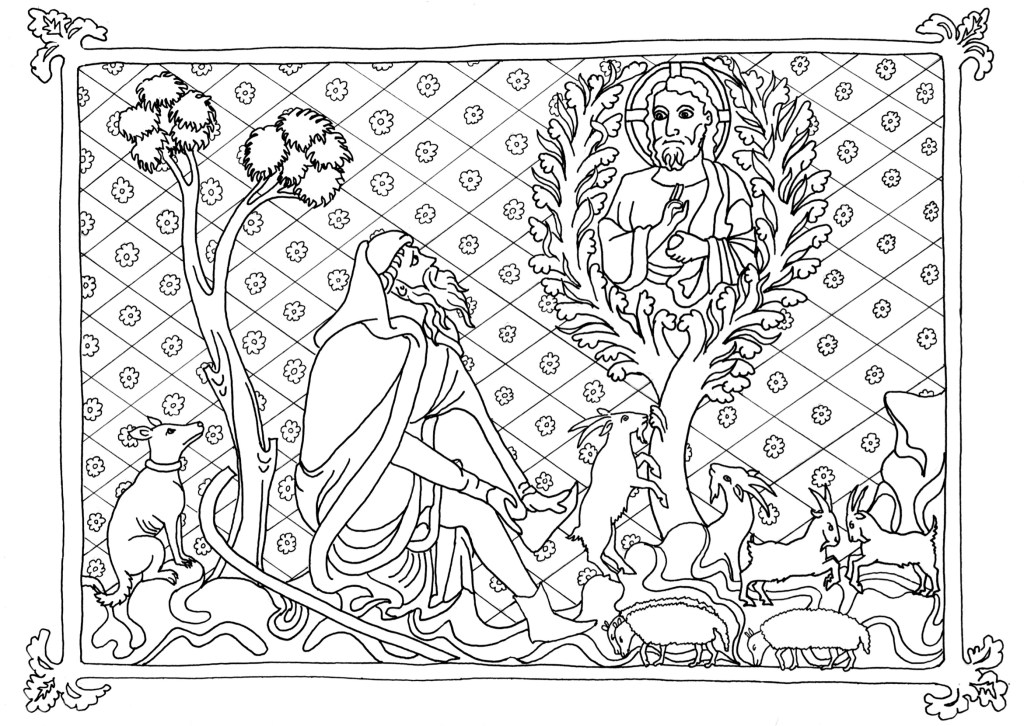
I was startled one day to see a tree on a city street in Spain (possibly in Oviedo) that looked just like one of the stylized trees in a medieval miniature. It had been so tightly pruned that it was no more than a few meters high and had pompoms of leaves at the end of short branches. It looked almost exactly like this tree in a depiction of Moses before the Burning Bush. I’d assumed the pom-pom tree was a whimsical invention of the artist. Instead it turned out to be a depiction of a type of pruning.

Copy of a medieval depiction of Moses before the Burning Bush. Original source lost. This is my own drawing.

Many medieval images depict scenes in towns or in gardens – domesticated landscapes. I expected there to be a lot of small, symmetrical trees there, since that’s what trees look like in that context. But what would trees look like when depicted in wilderness settings?

Here’s an example of a king being gored by a wild boar in a forest, in a painting from 1314. Very naturalistic trees. But the trees are not the subject, either. They are merely indicators of forest.
This is a delightful hunting scene. The forest in the background is playfully done, and with great artistry, too.
Hunting is a useful context for finding depictions of trees, and I’m trying to look for things well before 1500 (this one is from the early 1300s). But I’ve not found any images in which the trees in themselves are featured – they are most often a contextual background, or sometimes a useful feature (as when someone climbs a tree in the story).

More on this in the future, perhaps.

Dramatic landscapes

I was gently surprised yesterday to notice how many trees have very even, symmetrical shapes. Some are scraggly, squiggly, ziggy-zaggy, yes, but many have a species-specific crown shape that can be spotted even in a forested landscape seen at a distance. One just off to my left in that moment had a perfectly even curved crown. Another had puffs of leaves at the end of each branch; another was not just rounded on the top of the crown, but round all the way around, making a lollipop sort of shape like a child might draw. Then there are the ferny, pointy, skinny, flat and dozens of other shapes.

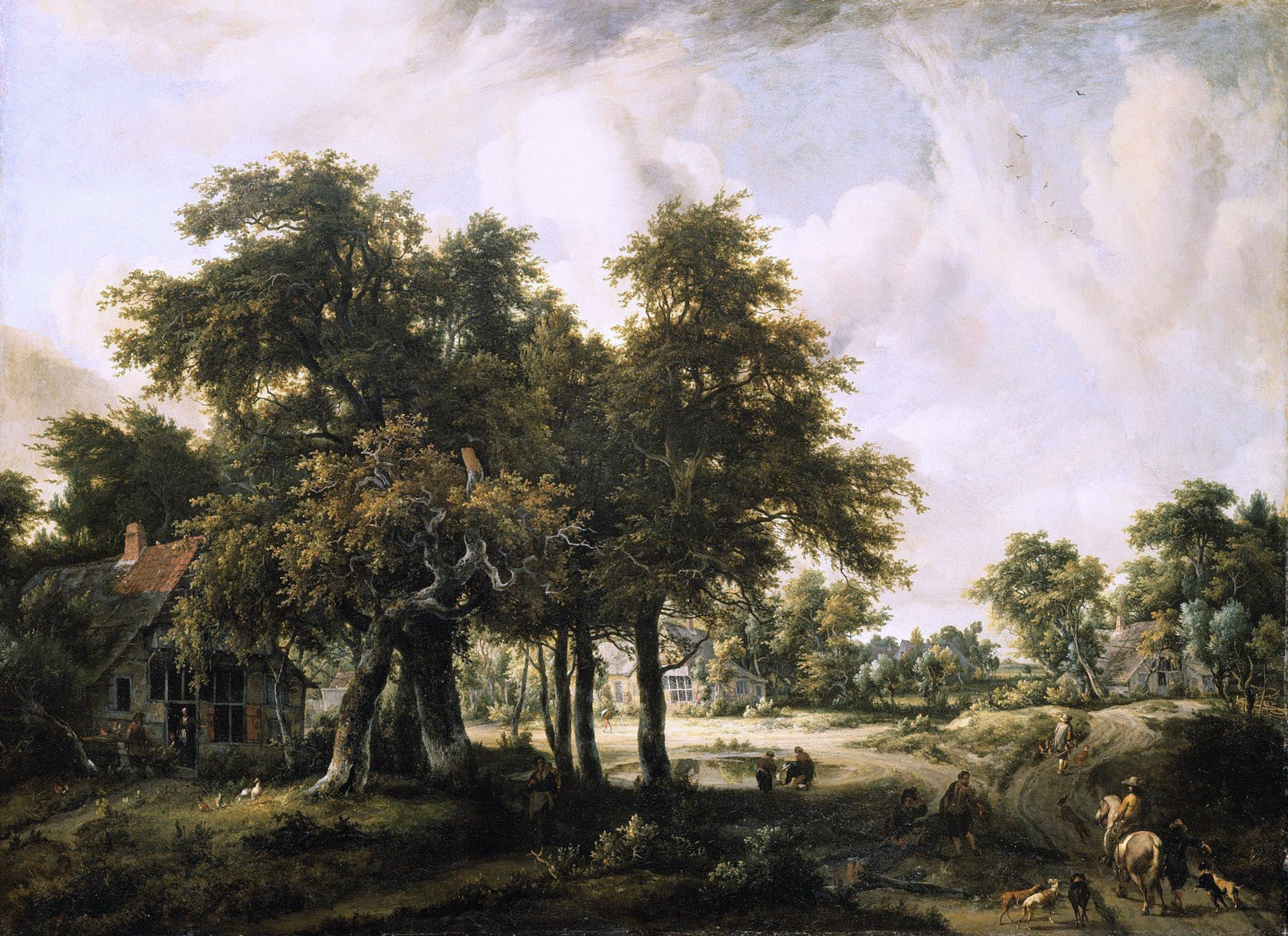
I thought I’d illustrate this post with some ‘trees in art’ found on wikimedia commons, but many of the paintings that resulted from that search featured dramatic trees that stood out in unusual ways – half dead, gnarly, enormous and craggy, twisted by the wind, and so on.

Here’s an example:

Or, looking back a couple centuries, to make sure it wasn’t mostly a 19th or 20th century phenomena:

I lost the original post, so am jumping ahead in what was originally a lengthier (and probably more tedious) thought process: I began to wonder if nature in and of itself, such as a featured dramatic tree, was a later development in Western art, and whether early depictions of trees in landscapes or as features would show a similar attention to dramatic trees.

So off to poke around some medieval art and see what I find. I’ll especially look for scenes that do not take place in a town or in a palace garden, to see how wild trees are depicted.

Ongoing angels

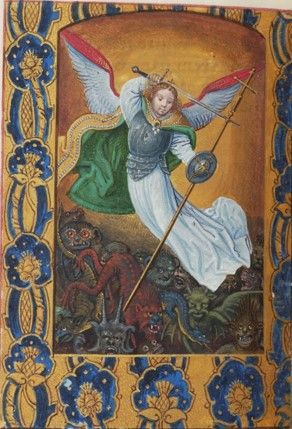
The angel I began embroidering is still underway. The text “Gloria” got done and redone several times as I experimented with stitches for the lettering. The wings are currently on their third revision, as there needs to be the right sort of layout of feathers to please my eye, and I had only sketched it loosely. I took out the second try, drew a design more clearly, and am now re-addressing that. Not sure how I might vary the colors. I like the multicolored wings found in many depictions of angels:

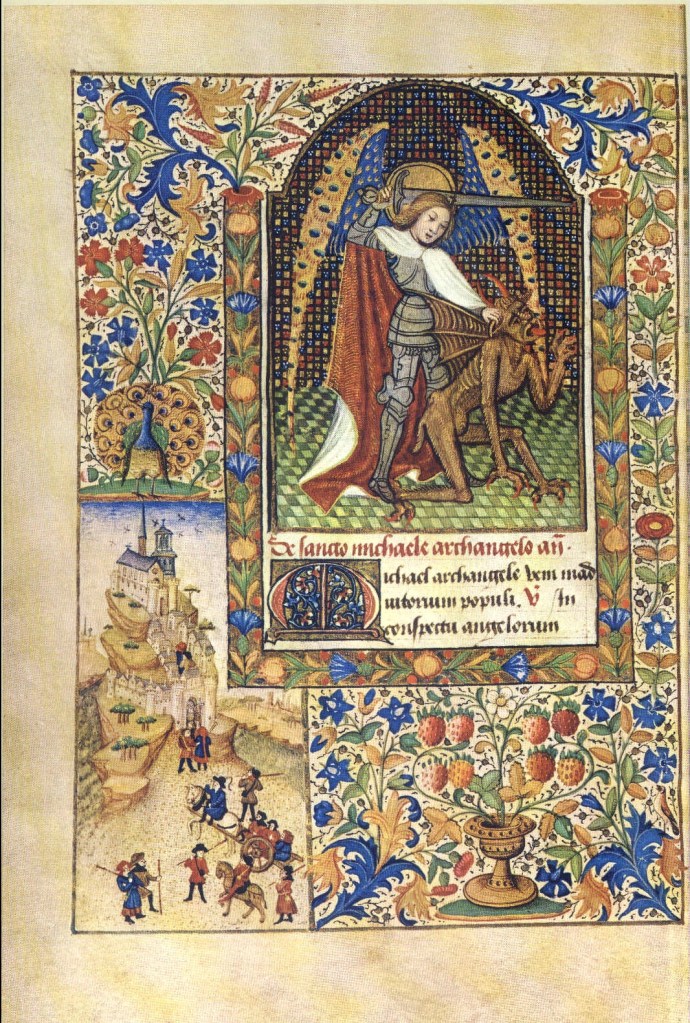
Red and white wings for Saint Michael
Red, green and peacock-eyed wings on a Gothic painting of Saint Michael
Blue, gold and Peacock wings on this Saint Michael
Rose and slate gray/blue wings on an Eastern icon of Saint Michael.

There’s an enormous variation in the styles and colors of wings. Mine’s going for green and gold at the moment:

Experimenting with shading, metallic thread, pencil drawing, lettering and hands and faces.

On another note: I’d like to thank Sarah Homfray for her excellent, encouraging and calming series of embroidery videos which I watch repeatedly. And also Steve Young, a horse trainer whose long, real-time videos with chatty commentary are also great company while I stitch.

I really miss being around horses. Today my former trainer sent me a video of my elderly mare. She looks great for her age!!

Painting the Heavens

Medieval illuminations often have interesting things going on in the sky.

Little angels peeking over the edge of heaven.
Patterns of blue-on-black foliage fill the sky.
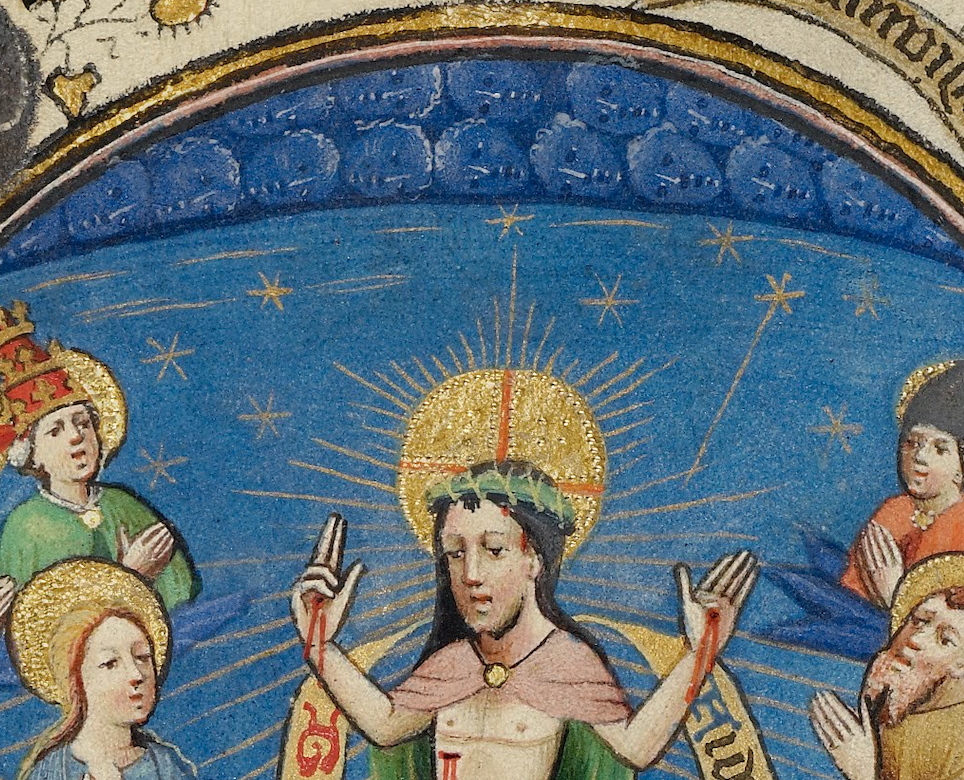
The faces of dozens of angels looking upon Christ and the saints.
God the Father and an array of little angels worked in tiny golden brushstrokes.
Some beautifully worked foliage patterns in the sky.
The angels are obvious, but there is also delicate white filigree filling all the blue of the background and sky.
This one is full of obvious angels, but a closer look reveals myriad half-hidden angels, too.
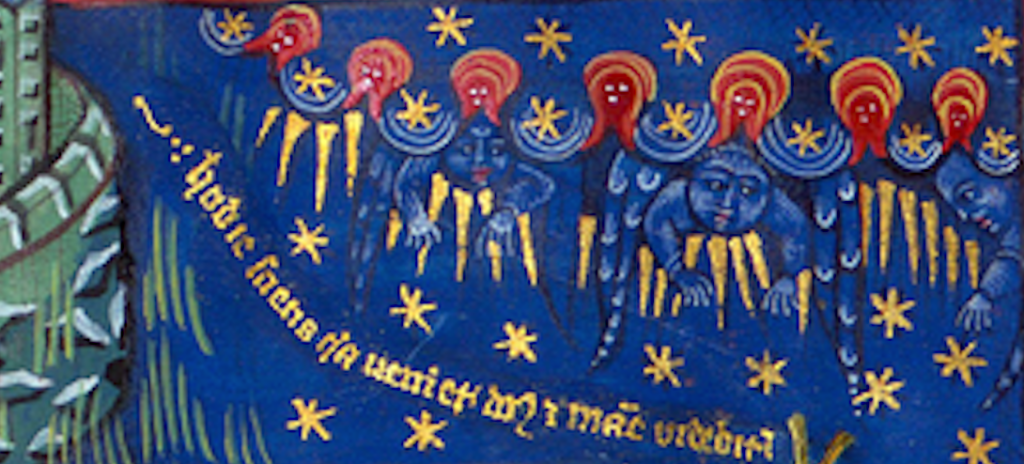
Here the choir of angels frames an ordinary sky full of stars.
And here some rather cute angels peak down at the Virgin Mary from a sky full of stars.

What Child is this?

A few years ago I found a delightful Baby Jesus at a sacred art store in Spain. During my trip to Spain I had gone to numerous Christmastide Masses where the adoration of the Baby Jesus took place afterwards: the priest would fetch a life-sized Baby Jesus from a manger built near the altar and bring it to the steps for the congregation to kiss. I loved that ritual. I could not recall seeing it in Brazil, so I thought I’d buy a similar image to take back as a gift for a priest I knew.

The Baby Jesus that I bought was more or less of this type, though closer to life sized. Photo: Circello, Nativity scene by Annassunta O., 03/01/16

When I got home and happily showed my purchase to some friends they responded with awkward flinches: “But he’s naked! Let’s get him some clothes!” I thought, my God, really? Are these people so strangely prudish that they’ve never diapered a baby? Have they never been in a household with an infant? I was used to toddlers running around in diapers. Newborns, not so much, as they were usually bundled up to avoid being chilly. But I’ve held my share of mostly-naked babies in my life and never thought it was strange.

The Baby Jesus was soon outfitted in a miniature chasuble and alb, which I thought cute, if a bit odd. But with all respect for local custom I delivered the gift dressed as required. (While trying to find photos of this from Brazil, I stumbled across this article about a similar custom in Mexico, though there it is specifically done for the Feast of the Presentation. There are a couple of good photos at the link.)

The subject came up again recently when I was showing some friends a painting I liked. Oh, but the Baby Jesus is naked! What good mother would leave her child undressed? Let alone Mary, Mother of God, who knew that her child was not just any old baby (which any mother would already consider a treasure!) but King, Redeemer, Saviour, Lord? Surely she wouldn’t just leave him laying about with not a stitch of clothes on, let alone do so in a desert climate in December and January, even less so in an unheated barn where the prickly straw and dirt floor would hardly be comfortable surfaces! This was the first time I’d heard something of a logical explanation for the apparent local custom.

If one needs greater authority than common sense, however, Holy Scripture specifies that the Holy Virgin wrapped the Christ Child in swaddling clothes before laying him in the manger. In fact, this detail was so important that the angels told the shepherds it was a sign by which they would recognize that they had found the Christ Child.

A swaddled Baby Jesus in a 14th century painting from Padua. Source.

I still wondered if the depictions of the Holy Child naked versus swaddled might have to do with regional styles, or with different epochs in art history. So I did a brief survey of images on Wikimedia Commons. Here are a few interesting things I discovered:

13th century Western paintings of the Nativity: the Christ Child is always in swaddling clothes.

14th century Western paintings of the Nativity: 15 examples swaddled, 3 dressed in a robe or gown. 1 draped with a loincloth, 4 naked.

15th century Western paintings of the Nativity: 4 swaddled, 41 naked, 4 draped in transparent sheer fabric that does not cover the nakedness.

Anything after the 15th century: naked, naked, naked

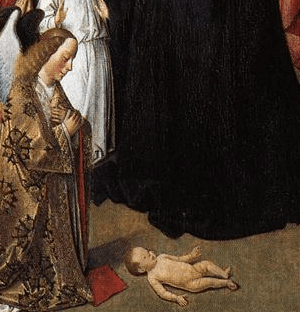
One odd result of the growing 15th century obsession with naked Baby Jesus is the plethora of images where the poor Baby is sprawled on the dirt floor at the feet of his apparently unconcerned parents and/or visiting angels or neighbors.

I checked Orthodox icons, too, for comparison. They were not sorted by date on Wikimedia Commons, my source of images. But the results were different. There were icons in which the Holy Infant was swaddled, dressed in a robe, or naked. But with a few rare exceptions this depended specifically on the context:

Baby Jesus in the manger: swaddled
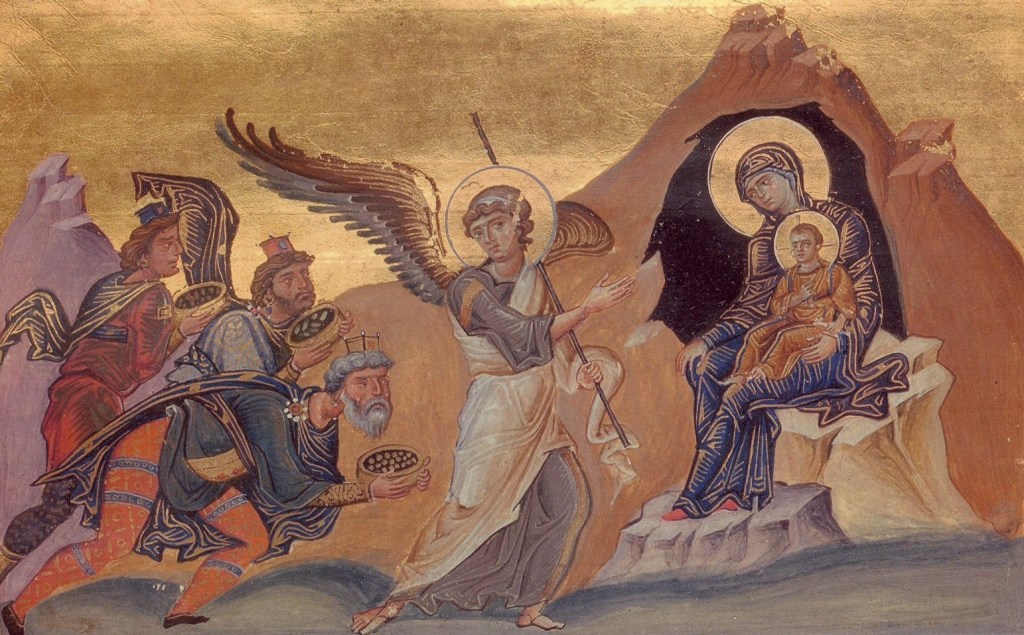
Baby Jesus enthroned on his Holy Mother’s lap while adored by the Magi or surrounded by saints or angels: robed
Baby Jesus being given a bath by the midwife right after his birth (this is a not uncommon theme in Eastern Nativity icons): naked

This icon has the swaddled Baby Jesus up in the manger, and the naked Baby Jesus being bathed in the lower foreground.
Here’s another by the same artist showing the third common style: the Christ Child wearing robes, while seated on His Mother’s lap, in the presence of the adoring Magi.

So there you go – the curious case of the dressing of Our Lord by His Holy Mother, as depicted in art and text over 2000 years.

God scolds Moses

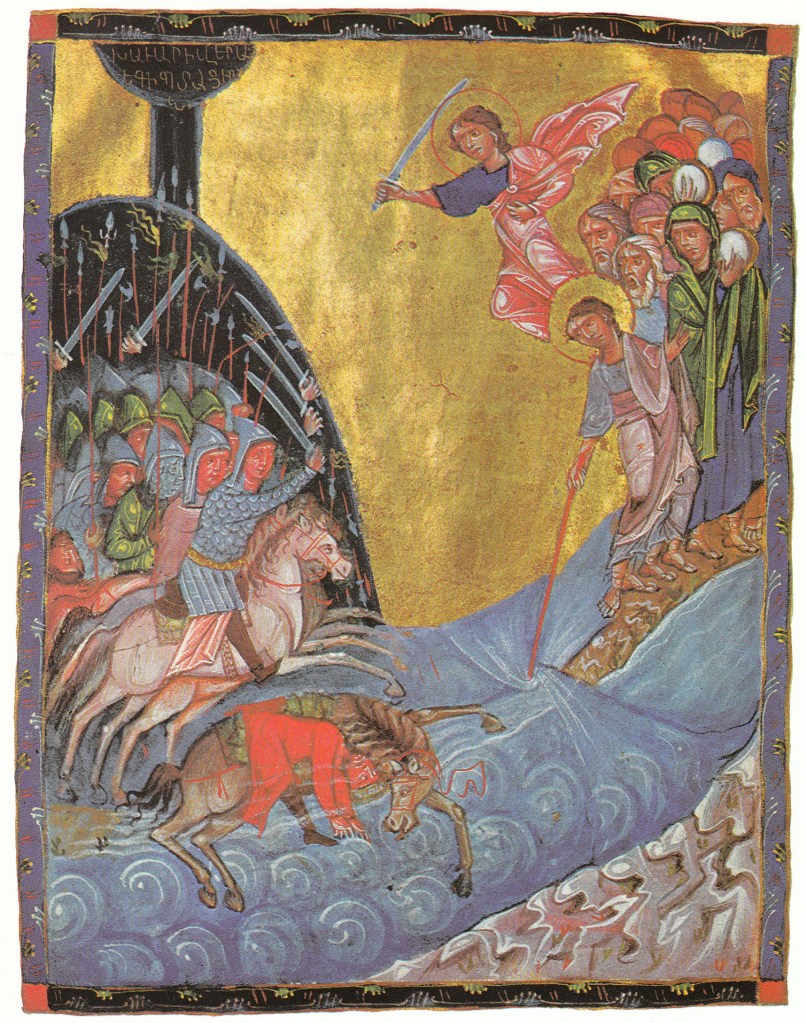
Moses is standing at the shore of the Red Sea. The Egyptians are closing in. A dispute arises as to what to do next, which Moses takes some time to resolve. He leads them in prayer, and then continues to pray, saying:

“O Lord of the world! I am like the shepherd who, having undertaken to pasture a flock, has been heedless enough to drive his sheep to the edge of a precipice, and then is in a despair how to get them down again…”

He goes on at some length. “But God cut short his prayer, saying: “Moses, My children are in distress-the sea blocks the way before them, the enemy is in hot pursuit after them, and thou standest here and prayest. Sometimes long prayer is good, but sometimes it is better to be brief.”

I had such a laugh at that. And it happens several more times, as Moses attempts to part the Red Sea and the sea argues with him, and he then talks to God again, who explains again what to do, and so on, repeating several more times “Don’t just stand there praying, Moses!!”

This is from Legends of the Jews by Louis Ginsberg. I love exactly this aspect of the tales, for they show such an intimacy with God.