Tag Archives: horses

Clarity

Years ago I had horses, and spent some time learning to ride, drive and handle the first one, and then a second one, and finally a third. It was the culmination of a lifelong fascination with horses, and an activity to which I devoted myself with unfettered enthusiasm. The poor horses had to work every morning, no matter the weather, as I arrived at the barn at some early hour just past daybreak and made sure each one had ‘training’ for an hour each. Over the course of the decade that I devoted to this activity we tried hunter pacing, fox hunting, competitive carriage driving, pleasure driving, trail riding, mounted games, and dressage. The last and youngest horse got sent off to learn to jump and (with a different trainer) to work cattle, just to make sure he was well rounded. And during this whole period I also co-wrote a couple of books with a horse trainer and ran a video business which involved spending hours and hours at clinics recording people’s sessions with respected trainers from far away.

Since moving abroad and living a horse-less urban life I spend hours a week watching other people train horses on YouTube.
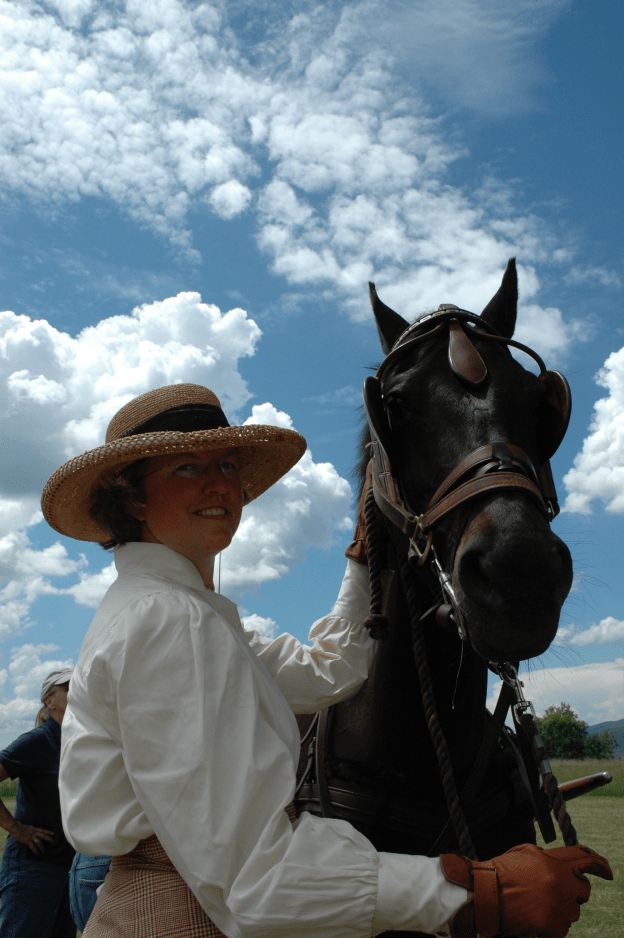
And this has led me to a few conclusions, none of which are different from earlier conclusions reached back in the day.

The main conclusion is that most higher animals are very aware of visual communication, more even than aural. And humans seem to have a particular quirk in which our minds run on Track A while our bodies carry on on Track B, C or D. Animals tend to do what they are thinking, with some rare exceptions of duplicity in some of the more intelligent ones, who can sneak, hide things, pretend, and so on.

But I can’t tell you the number of times I’ve seen people dealing with horses who have some of the following comportments, and don’t understand why their horse is hard to handle:

Agitated unconscious body language: example being a woman who I spoke to once who was standing at the side of her new pony – supposedly a nervous one, and hard to catch — who moved her feet and flailed her arms randomly while rapidly speaking about something or other, sometimes even hitting the pony unintentionally while gesturing. The pony stood as best he could, flinching when her hands came close to his head or neck.

One of the most outstanding features of the trainers I most admire is a profound calm. Their calm, confident, silent presence alone is already interesting to the horse, and provides a ‘refuge’ for the horse to pay attention to. In a few minutes the trainer can often halter the horse, lead the horse, mount and ride, and so on with none of the expressions of anxiety that the horse exhibits when handled by the owner.

One of the great demonstrators of this technique is Warwick Schiller. Another is Michael Peace. In both cases they have such a present awareness that they do not need to use large cues to clarify what they want. The horse can respond to very small cues because there is no ‘static’ obscuring the message. The presence of the trainer is like a break in the clouds, with everything suddenly revealed.

Other good trainers are slightly less quiet, and use louder cues, but use them with great consistency. The clarity of consistency in this case overcomes the problems the owner was having. In these cases the owner is often tentative, which the horse interprets as their companion being nervous and fearful, which makes the horse worried and unconfident. The arrival of a trainer who is confident and uncomplicated, even if a bit rougher than necessary, clarifies everything: yes means yes, no means no, and I always know if the human is saying yes or no. The owner is then retrained to say ‘yes’ and ‘no’ instead of ‘well, I’m not sure, maybe, could we sort of should we, oh dear.’ And the horse, relieved of the morass of confusion, relaxes and starts to engage instead of wishing he could be anywhere else.

And then there are the range of horses who are perfectly good at doing this or that, but aren’t really trained so much as they have memorized certain tasks and enjoy human company. If anything unexpected happens they are a bit lost. But for many horses this is enough for a routine life of giving riding lessons or going to shows or just being a pet.

Living in a foreign country where understanding is always impeded a bit, I am a big fan of clarity. And I notice how relaxing it is to spend time with someone who is present and aware, where one can exchange some longer thoughts or work on a task together without the noise of agitated movement, agitated thoughts, or running hither and yon. One can find that calm in God’s presence, but now and then one runs into a fellow person who radiates that same calm, and it’s a real delight to share in it. Always grateful when that happens.

Why that road?

My husband pointed out the other day that I’ve now lived in Rio de Janeiro for longer than I’ve lived in any other town in my life. Thirteen years! Eleven of them in the same apartment. The first two years we didn’t realize we were staying, so we just rented some temporary places notable mostly for various weirdnesses. But not enough time has passed to detail that!

Nevertheless, this came to mind the other morning when I dreamed I was visiting a house in the town I lived in for a good part of my childhood (but only 10 years!) — Yellow Springs, Ohio. I can’t recall a dream in which I was in my college hometown (Bloomington, Indiana) or in Manhattan or Hoboken or, for that matter, Madrid or Chicago or Wanfried-an-der-Lahn, or dozens of other places I’ve visited over the years. Any time I dream vividly of a recognizable place, it’s either Yellow Springs or Sharon, Connecticut.

So here I was, not for the first time, dreaming that I was visiting the old house on Hyde Road where a childhood friend had lived. In dreams set in Yellow Springs the most common locations are Hyde Road or the Glen. I suspect Hyde Road was particularly memorable because it had, in the 1970s, many horses pastured along the roadside, and I would ride my bike down there as often as I could just to see the horses.

My friend’s old house on that road was striking for various reasons. Most other people’s houses were interesting, if only because at the age of 8 or 10 I was now visiting other kids in their homes more often, and for the first time really getting to know the details of how other families lived. One had the coolest squishy linoleum in the hallway, which would hold the imprint of your fingernail if you pressed it. (An activity forbidden as soon as it was discovered by the mother!) Another had a tree house and a strange structure called a carport. It was the only house with a carport I had ever seen; the rest had garages. And this old house on Hyde Road had a bunch of strange features that I remember vividly to this day. One was an enormous brindled dog that I mistook for a tiger on my first visit. Another was a little ‘house’ down from the back door where milk and butter had once been stored in the cold waters of a spring that flowed there. And most fascinating was a secret room, hidden below a large trapdoor in the living room floor, which was in turn hidden by an oriental rug (in my memory, at least). I was told it had been used to shelter people escaping slavery, since the town had been founded by Quakers, who were active in opposing slavery and helping those escaping across the Ohio River to freedom in the North.

So here I was again, as an adult in this dream, going down this same road, and seeing that there was a house-tour event going on. So I wandered up to the house and asked if I could take part in the tour. I no longer recall what happened after that. It was a visually vivid dream, but not otherwise very interesting.

When dreams are set in Sharon, CT the landscape tends to be the main feature – usually I am traversing the neighboring farm fields for some urgent reason or another; or I’m addressing problems in the gully or wooded hillside beside the little cottage we once lived in; these problems usually require traversing the neighboring fields to get the help of the neighbors. I don’t recall anything particularly memorable at the moment. It’s again the visual impact, the clarity of memory of those landscapes, that sticks in my head the most.

Both places had horses in common.

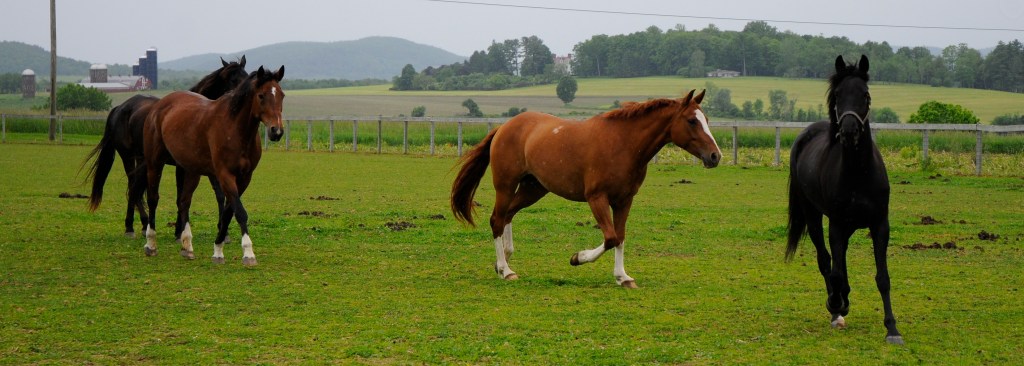
I don’t have any photos of Yellow Springs, but one can find it on google. Of the landscapes around Sharon. My favorite sort: rolling farmland.

Ongoing angels

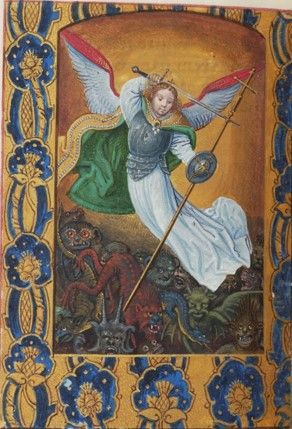
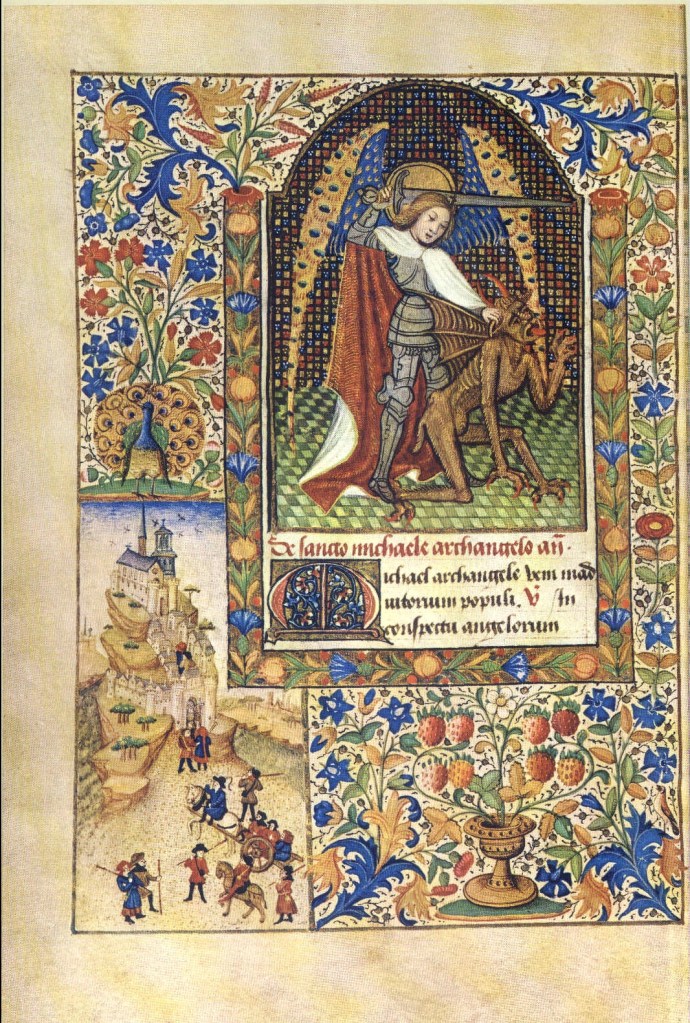
The angel I began embroidering is still underway. The text “Gloria” got done and redone several times as I experimented with stitches for the lettering. The wings are currently on their third revision, as there needs to be the right sort of layout of feathers to please my eye, and I had only sketched it loosely. I took out the second try, drew a design more clearly, and am now re-addressing that. Not sure how I might vary the colors. I like the multicolored wings found in many depictions of angels:

Red and white wings for Saint Michael
Red, green and peacock-eyed wings on a Gothic painting of Saint Michael
Blue, gold and Peacock wings on this Saint Michael
Rose and slate gray/blue wings on an Eastern icon of Saint Michael.

There’s an enormous variation in the styles and colors of wings. Mine’s going for green and gold at the moment:

Experimenting with shading, metallic thread, pencil drawing, lettering and hands and faces.

On another note: I’d like to thank Sarah Homfray for her excellent, encouraging and calming series of embroidery videos which I watch repeatedly. And also Steve Young, a horse trainer whose long, real-time videos with chatty commentary are also great company while I stitch.

I really miss being around horses. Today my former trainer sent me a video of my elderly mare. She looks great for her age!!

Shrek

We were waiting by the stables for a rental horse ride in rural Brazil. When we arrived a competent looking man was leaving, and said our guide was running just a bit late. “Late like ten more minutes or half an hour?” I asked. “Oh, not half an hour. Maybe ten minutes!” I assumed he had a terrible sense of time and was also being optimistic and tripled the estimate.

About 20 minutes later a man stomped through the gate. He was broad-shouldered and neckless. As he climbed the short driveway he swung his clenched arms in the air and gave a couple of howling roars. I assumed he might be a non-verbal disabled man, perhaps a relative of someone who lived nearby. Once he reached us he stammered some not terribly coherent conversation. It took a few minutes to understand that this was our guide. We frowned at each other in great doubt, but sat patiently near the stables while he stomped around swearing (gently) and howling at the horses, who were not interested in being in a hurry.

By day two we had become accustomed to his alternating grunts, howls, roars and conversation. He appeared to be, after all, someone of fairly normal mental function and good intentions, and the odd noises were simply his enthusiastic expressions of frustration when any minor difficulty was met. He was also, perhaps, socially awkward and shy, and so he seemed much more normal by the end of the second day when we drew him out with friendly conversation about horses, the weather, the route, and so on: “What is this plant good for? Does it have fruit?” I asked. “It’s good for giving thorns,” he grumbled.

In any case, we soon decided he reminded us totally of Shrek. And once that image was in our minds we couldn’t shake it, so Shrek he will remain.

Great Geeky Girls

Here are some of my favorite geeky girls who have fun YouTube channels:

Sam van Fleet: This girl picks out wild mustangs, trains them from zero, and shows and sells them. When I was that age I don’t think I was doing anything useful. I love watching her attentive, careful training and listening to her thoughtful analysis of what’s going on with her horses. I used to have horses and did some training, so it’s a rabbit hole I’m thrilled to re-experience vicariously. Also impressive: Camille’s Mustangs. Really lovely to watch these young women working.

Karolina Żebrowska: Karolina has quirky interests mostly involving the history of clothing. She’s a funny story teller and I love watching her walk through her careful research on oddball subjects like “What would Snow White really have worn?” Since I do some sewing and embroidery (at a very basic level!) it’s inspiring to watch Karolina work with sewing projects, too.

Bernadette Banner: Another expert in historical costume, and also a great story-teller. My favorite so far is when she bought a Chinese knock-off of one of her own dresses to compare to the original. Her projects are always exotic and entertaining.

Nicola White: Apparently people in England go hunting for lost treasures in the tidal mud of the river Thames. This is somewhat gross, but also adventurous and rewarding. They find dead people, lost jewelry, strange artifacts…after all, the area has been inhabited for centuries, and the inhabitants have spent those centuries chucking stuff in the river… In any case, Nicola has a particular knack for story telling and her videos are intriguing and fun.

Musical Notation is Beautiful: The lovely woman who does this video series (Elba, if I caught her name correctly in the video?) gives fascinating accounts of different kinds of musical notation. If you like early music, calligraphy, medieval arts, or any related subject, check this out!

Caitlin Doughty: Widely known for her video series about death. Caitlin is a mortician and has all kinds of interesting stories to tell about modern and historic deaths, the biology of death, weird and interesting facts about dying and funerals. She’s also a good story teller and her videos are very engaging.

Speaking of death, I must add a fun watch, Sister Theresa Aletheia Noble, FSP, who has written a book of religious meditations on death and appeared on several television programs and podcasts to talk about it. Sister Aletheia doesn’t have her own channel, but you can see several of the interviews here.

Left front foot

I took lots of riding lessons. Lesson number one was that riding is a very specific and regulated activity. One approaches the horse so, touches him so, grooms him so. One cleans the left front foot first, standing exactly so, moving ones hand so, scraping the dirt so. Only by the good fortune of it being the 1970s I was not required to wear what are now considered required items for riding a horse: tall boots, stretchy pants, helmet, gloves. Sneakers and jeans were enough. And there lies the giveaway that all the enormously expensive gear, and all the elaborate rules of riding, are just upper-class stylish expenditures and military exercises to train cavalry trickling down to the peasant class.

When I finally encountered working horses, something easily encountered when riding in Brazil, I discovered that one can actually ride in shorts and flipflops, with a saddle made of a folded blanket or a girth made of leftover twine, on a horse whose loose shoe can be hammered back in place with a rock found alongside the road.

I then discovered that actually nearly all the thousands of dollars I spent on specialized sports gear over the years was ridiculously wasted. One doesn’t need a different pair of shoes for each activity, nor a special pair of pants for hiking, different from the ones used for bicycling or swimming or fixing the roof. The vast majority of people in the world* don’t have the money for that, and those of us who do are spending it like water in order to show people how cool we are. Outside of a very tiny percentage who are participating in competitions that oblige the use of matching outfits, there is simply no need.

*And not just in foreign countries. I was once at the bus station going back to college, with my sneakers tied to the outside of my duffle bag and my sandals on my feet, when a five year old girl behind me in line said softly, “Mama! She has TWO shoes!!”

After-dinner video rabbit hole of the week

I love watching these Criollo horses. I like the unexpected details, like the way the saddles are constructed, or the way the narrator says “this horse is accustomed to being kept in a box, and knows how to eat commercial feed. In Brazil, rural people sometimes say, with some disdain, that such and such horse is “a box horse” – meaning one who has little experience outside a show-ring or riding stable, and is fussy, hard to handle, easily startled, and not much use for real work. It’s an amazing thing to ride a horse that’s been raised on the open range. Their sure-footedness is amazing. They are extremely smart about footing, routes, and obstacles.