Before I got sidetracked by medieval beds, I had intended to ponder the different kinds of staying in. There’s the staying in because it is so calming and cozy; and the staying in because one is terrified of going out. I suppose that’s a bit of a continuum, with just a more pragmatic motivation at one end and a more fearful anxiety at the other. Nonetheless, staying in is seen as a more comfortable option.
I think there may be indoor and outdoor cultures, too. I ran into a middle aged Canadian woman recently, who cheerfully joined me in remembering how we used to run around in the woods as kids, having long adventures, venturing miles from home.
And yet I know many people — in the US as well as in Brazil — who rarely leave their homes, or only by car for necessary outings like doctor’s appointments and groceries.
The motives and contexts seem as diverse as possible, at least anecdotally. Big house, small house; hot climate, cold climate; rich, poor; safe neighborhood, rough neighborhood; car, no car…
Off to find another illustration, as that’s half the fun:
The other day a few women I was talking to agreed among themselves how happy they would be to just stay in, cozy in their own homes, instead of being obliged to go out to various other places so frequently.
And I thought there’s something to agree with in that, as I too really enjoy staying home, where everything is just as I prefer it, comfortable, cozy, and quiet.
So I thought to find a picture of someone snug in their bed in order to illustrate the idea, which led to a rather surprising discover: in searching medieval art, most depictions of people in bed are rather drama-filled. Besides the expected depictions of adultery, there are many other interesting categories of illustration:
One of the most beautiful is of poor Tobit getting a blinding eye-full of bird poo, which leads to all sorts of interesting adventures (See the Book of Tobit in the Bible for the full story). This one is worth a close look. Such beautiful detail, from the fabrics to the mechanics of the cooking setup, and, well, to the providential bird.
Being killed in bed is not uncommon, as many images depict. Or, as in the following, being awakened to receive the news that other people have been killed:
Of course there is being dead in bed, with scenes of mourners, angels or devils gathered around you. This one is especially spectacular, as it is the death of the Virgin Mary, with all of Heaven gathered around her to carry her up (by tradition she rose bodily into Heaven, rather than just in spirit).
/
If one isn’t dead yet, one might be sick, and pictures of people being attended to while sick are common. Here’s King Louis IX being healed by a piece of the True Cross:
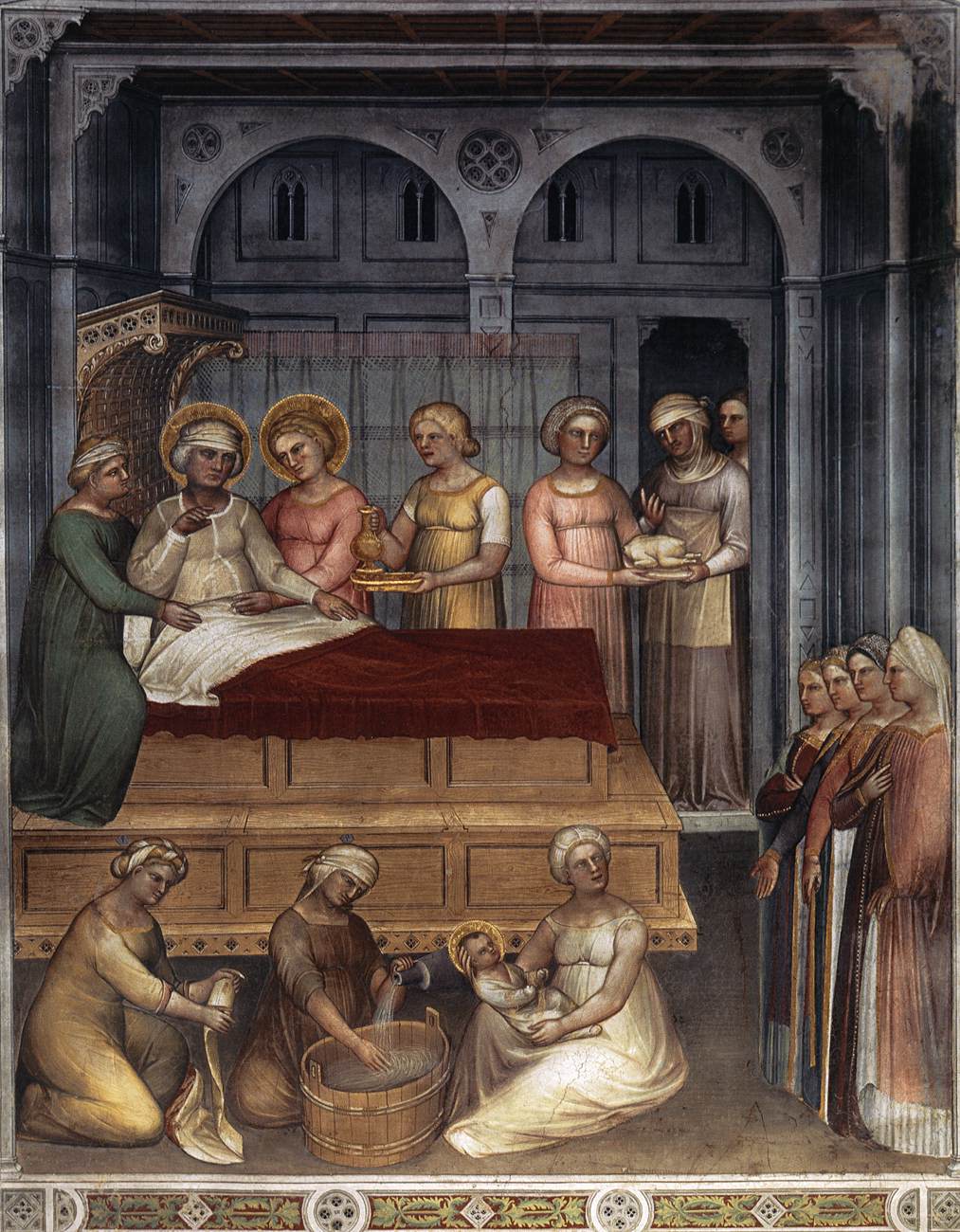
Of course, childbirth is often centered around a bed in art from this period, and in many cases the pictures include adjacent scenes of midwives washing the child, servants bringing food to the tired mother, and family members peeking in from nearby. This is the birth of John the Baptist, in a beautifully detailed architectural setting:
And finally, there is socializing in bed, or at least near the bed. It’s not uncommon for scenes of (usually royal) meetings being held with the bed centrally featured in the scene, even if it is neatly made and not being used. Here are a couple examples:




 Joys and sorrows in praise of God